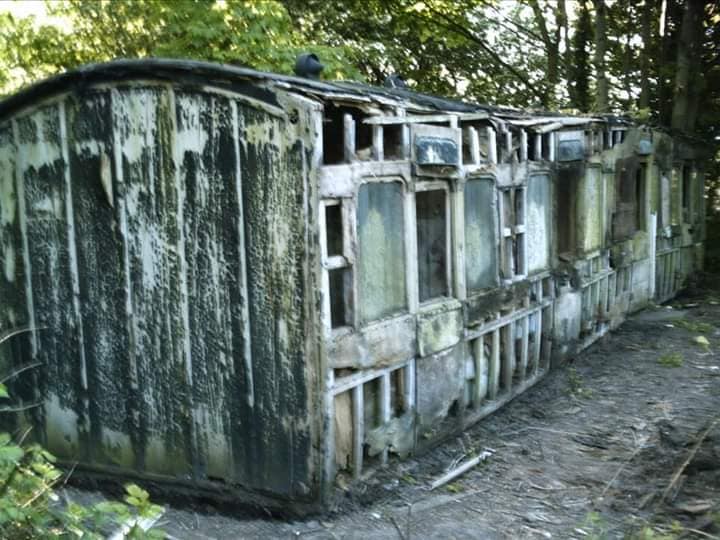
Our 1890 L & Y carriage discovered on Raikes Farm, Stanah, 2008
A Lancashire & Yorkshire Railway carriage (number 210), built in 1890. Records show that 82 (32'0" x 8'0") first class carriages were built between 1882 and 1894, with 47 still remaining in 1921.
The most up-to-date record of 6 wheel 4 compartment first class L & Y carriages shows there to be just two in existence; the PWRS one and one owned by the Lancashire and Yorkshire Railway Trust.
Early in 2008, David Evans (committee member) had heard from a friend that he thought there was an old railway carriage in the wooded area of a farm in Thornton.
Telephoning Dennis Goy, another PWRS member from the car park of St. Nicholas Owen Church at Stanah, David, having decided to find this carriage, said he was looking through the trees at what looked like the end of a railway carriage in an overgrown area of a farmer's field on Raikes Road, Stanah.
In discussion, it was decided to try to find the owner of the land as soon as possible. Within two days we had found the owner to be a Mr. T. Hodgkinson of Raikes Farm, Stanah. A visit was made to Mr. Hodgkinson and after explaining why we were there, he told us that the carriage had been on its present site for at least 95 years.
It is believed to have been brought there during his father's time by four horses on a cart and was intended for a railway worker to live in who had been injured. In fact the railway worker never did live there.
The carriage then stood empty for a number of years, but during its life, three families had allegedly lived in it, including the Isherwood family who lived in the carriage for a while with their children.
According to Mrs. Hodgkinson, wife of Mr. Hodgkinson who took over the farm from his own father in 1958, the last tenant of the railway carriage was a Nurse Procter. She was the local district nurse and had lived there from time to time since the 1930s.
Her family lived on Cornwall Avenue in Blackpool but, as she worked mainly in the Poulton and Thornton area, she often stayed for long periods in the carriage.
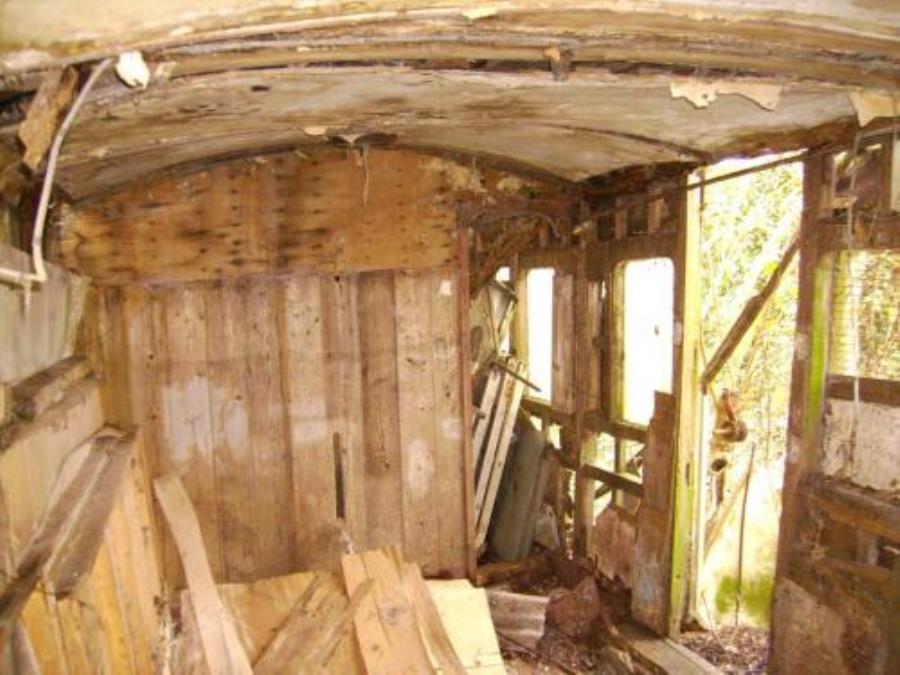
L & Y carriage during removal of stored items and detritus, 2008
Nurse Proctor had electricity installed and had a coke stove inside the carriage. The inside of the carriage had had the centre partition removed to make the living area and the two end compartments had been turned into bedrooms.
It had a small outside room built from the wood from this partition to put the cooker in and it was built over one of the doors leading off the living area. Toilet accommodation was in a separate hut.
Nurse Procter's nephew said that he recalled visiting her there in the summer. Although derelict when discovered, he and his sister remember that back then it was very nice inside, with beautiful polished wood.
There was gas lighting in the carriage and, although he recalls a wooden barrel collecting rainwater for general use, his aunt had to go the farm with a bucket every day for a supply of fresh water.
The carriage even had a name - Peace haven! The brother and sister both recall happy and idyllic childhood times spent in and around their aunt's unusual home, so a haven of peace and tranquillity is probably exactly what it was.
Unfortunately for Nurse Proctor the local council at that time decided that it wasn't suitable for living in as there was no water supply or sanitation.
After the Nurse left the carriage was used for chickens and turkeys, then subsequently for storage and left to nature.
Mr. Hodgkinson telephoned a few days later and David and Dennis went down to visit the carriage. They trudged through the wooded area and it wasn't until they were almost on top of it could they see it was a railway carriage.
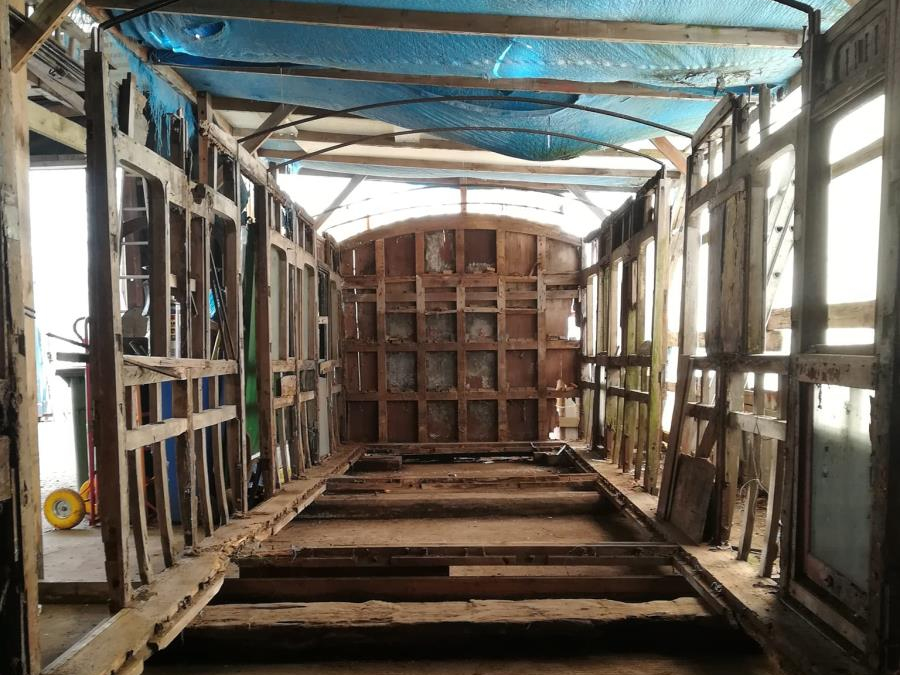
Work started on cleaning and dismantling the carriage, 2022
The mind boggled as to how it was so well hidden and that it had survived in that one place for over 95 years. It was surrounded in vegetation and trees had grown over the top of it. The inside was being used for storage. The floor appeared to be covered in several inches of soil.
The framework appeared to be in good condition except the roof where it joined to the carriage. The trees constant dripping had rotted the wood.
They returned to talk to Mr. Hodgkinson and he agreed that PWRS could have the carriage as long as we respected his land and did not have people wandering around without David or Dennis being present.
Work started a few weeks later and it was kept to just a few people working at any one time. The vegetation was the first to be cleared so that we could see what the carriage condition was really like.
The framework could be seen through the panels that had disintegrated. It was in excellent condition including the beams at floor level. The eight doors were still there and most had the original glass still in them. The roof was the part that caused most concern as it had come away from the carriage in several places. The last part being the cleaning out of the inside.
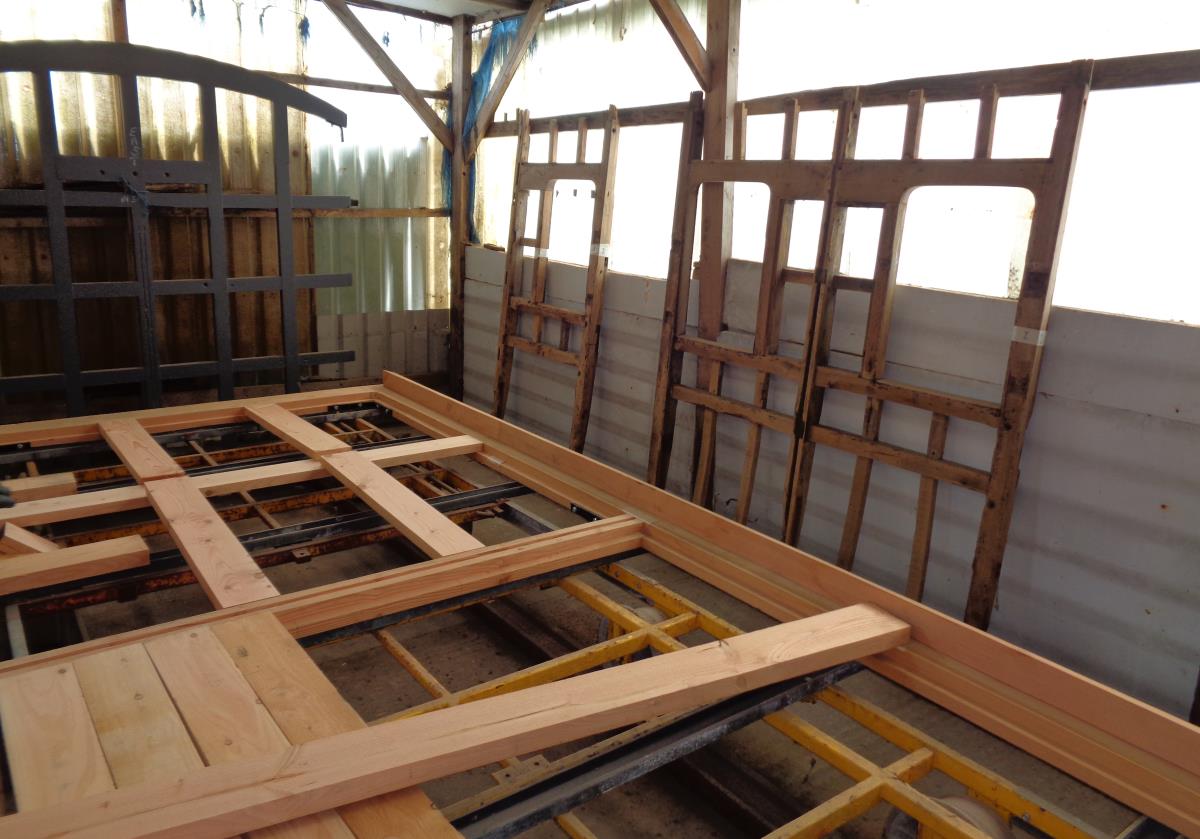
Old and new wood together on the PWRS open day, 2023
With preparatory work for removal completed, talks were instigated with Fox Bros about the removal. Mr Paul Fox made a visit to the site and after inspecting the carriage and area agreed it could be moved and offered to move it free of charge!
The great day came for the removal. The lift started and everybody went very quiet with various thoughts as to what would happen to the carriage. With fingers and toes crossed, it was off the ground by several inches and no creaking or groaning from the carriage at all.
It was fantastic to see it gently swinging, still in one piece; even part of the rotten floor had come with it.
The crane started to swing it slowly round to place on the waiting vehicle. Then problems, they'd forgotten about the trees above the road onto the site which were in the way of lining up the carriage. After 45 minutes of struggling they managed to lower it onto the vehicle and a large sigh of relief went up.
Thanks went out to everybody who worked on the carriage prior to removal, Mrs Hodgkinson for letting us have the Carriage, Fox Bros for moving it and NPL Estates for storage.
Sign up for Membership for just £15 (Adult), £5 (Child) or £20+ (Associate).
Volunteer your time.
Download and complete the Rolling Stock Fund and / or Vintage Carriage Appeal donation form.
Donate via PayPal or Credit Card.
Support us when online shopping.

Donate electronically to our bank account.
Bank: Santander
Account Name: Poulton & Wyre Railway Society
Account Number: 89012757
Sort Code: 09-01-28


© Poulton & Wyre Railway Society 2018-2026
Donated by: EasierThan Website Design, Thornton Cleveleys