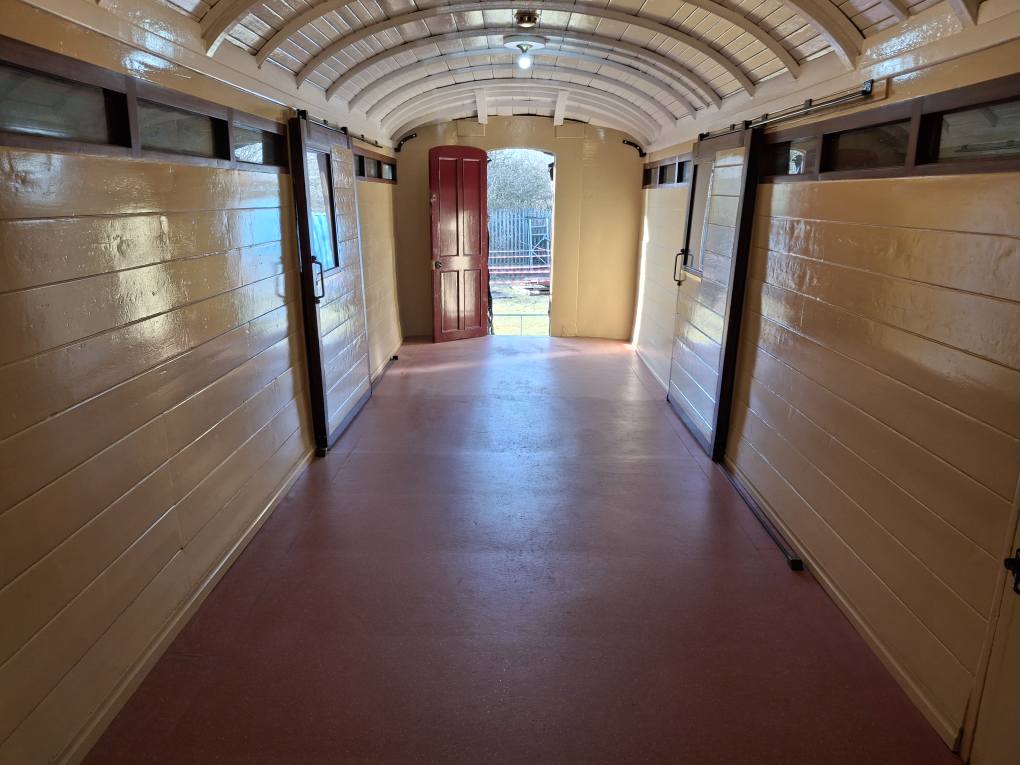
Pigeon carriage interior nearing completion, 2025
Pigeon racing was a popular pastime in coalmining communities. It became popular by the advent of legislation, which limited the length of the working day and by the growth of the railway network in Britain, which opened up the possibility of affordable travel for the working classes.
Pigeon lofts could be seen in most coalmining communities and pigeons were said to be the poor-mans race horse. Pigeon racing became more formalised as it developed; rings were attached to the birds legs to aid identification, specialised clocks were introduced to record exact time of arrival and winners being determined by average speed rather than by arrival at a secondary location.
Homing pigeon rail traffic ran from the early 1900s until the 1970s. Some were transported by ordinary passenger trains, being conveyed in the brake carriage, whilst other were transported on special trains which ran during the summer months for weekly races organised by pigeon racing clubs.
Some were even taken to the Channel Ports where the pigeons were transferred to ferries to be taken to the Channel Islands or the continent for longer races.
LNER Standard 61' 6" teak-panelled carriages - Brake Gangway (Pigeon) (BG(P)) Diagram 245 built on the all-welded steel underframe with angle trussing. A ducket (lookout) is located on the same side as the guards seat and break wheel. The carriage has three pairs of loading doors on each side and a separate inward opening door on each side for the Guard's use.
BGP carriages built to diagram 245 were principally intended for conveying racing pigeons and were fitted with drop-down racks to hold the wicker baskets. A gangway connecting door is located at both ends of the carriage to permit the pigeon owners to travel with, or check up on their birds.
Diagram 245 Carriages ran on the 'Gresley' 8'-0" wheelbase 'Heavy' bogie with single bolster. They were fitted with Pullman corridor connections and automatic couplers, and retractable 'clipped top' 9" diameter buffers.
4 sets of double door removed and replaced with single sliding doors possibly during the time that the carriage was transferred from the London North Eastern Railway (LNER) to British Railways (BR) in 1948.
Evidence of parts once belonging to the London Midland Scottish Railway (LMS) being used (siding door handles) which would probably have been available as the transfer of LMS assets to BR in 1948.
The carriage was built in York in 1938, (BGP 4237, later 70460) for the sole purpose of carrying racing pigeons.
It was later converted into a Breakdown Train tool van (ADB 9756252) in 1972, operating out of Grangemouth.
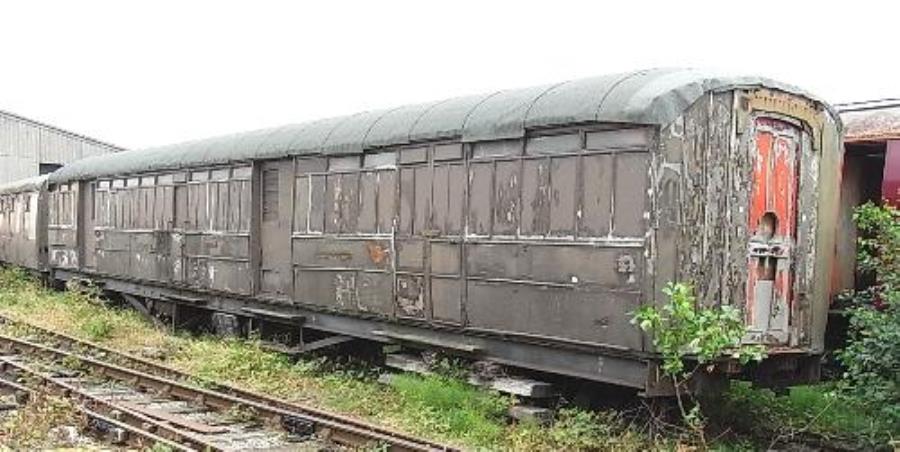
The pigeon carriage languishing at Steam Town, Carnforth, 2014
Pigeons are mentioned in Stanley Accrington's nostalgic railway song, Last Train. He was the last Station Master at Rochdale in Lancashire and one of his duties would be to arrange for the release of the pigeons.
At three in the morning when I used to sign on, I lie awake all in a dream; I'm a guard on a Special bound for the coast, On a 4-6-0 getting up steam. We've got packages for printers, pigeons to release,in Spare seats after Heywood? Not one. And the last train to Fleetwood has gone.
Sign up for Membership for just £15 (Adult), £5 (Child) or £20+ (Associate).
Volunteer your time.
Download and complete the Rolling Stock Fund and / or Vintage Carriage Appeal donation form.
Donate via PayPal or Credit Card.
Support us when online shopping.
Donate electronically to our bank account.
Bank: Santander
Account Name: Poulton & Wyre Railway Society
Account Number: 89012757
Sort Code: 09-01-28


© Poulton & Wyre Railway Society 2018-2026
Donated by: EasierThan Website Design, Thornton Cleveleys